
Manufacturers sometimes measure a shipping carton based on the bottle alone. However, this box usually gets too tight once the divider is fitted inside. The extra thickness might just be a thin piece of cardboard between two bottles. Still, you have to add up that extra room along the entire row. Because of this added space, the final outer case changes. A different issue happens if you make the box too loose. The partitions will shift around. As a result, the bottles are not held safely in place. Proper custom wine shipping box dimensions need to consider a few key details. You must plan for the bottle and the specific divider system. Finally, you also need to think about how people will handle the filled carton.
For a single bottle, the packaging layout may be straightforward. A six-bottle or twelve-bottle case adds a grid, shared walls, and questions about packing direction. Internal dimensions should be settled before external dimensions, not copied from a stock carton. The goal is a box that packs consistently and protects the bottles without wasting space.
Which Measurements Control Wine Shipping Box Dimensions?
Start with the actual production bottle. Capacity is not a reliable substitute for external dimensions: two bottles marked 750 mL can differ in body width, shoulder shape, total height, or closure. Those details determine the smallest usable space, particularly when a partition or formed insert contacts more than one part of the bottle.
Bottle Envelope and Packing Orientation
Record overall height with the final closure fitted, maximum body diameter, and the base diameter. Check the shoulder profile when the insert includes a collar or upper restraint. The filled bottle weight belongs in the specification as well, because the carton base and the handling method must support the complete load. A technical drawing helps, but a physical bottle reveals where an insert actually touches glass or a paper label.
Decide whether the bottles will stand upright or lie horizontally. Vertical layouts usually use the body diameter to establish a grid footprint and the bottle height to establish the carton depth or height. Horizontal trays use a different orientation, and a simple vertical-divider calculation will not describe them accurately. Keep the orientation consistent from the first structural drawing through sample approval.
Allowance Is Not the Same as Empty Space
A bottle should not be forced into a cell. Some clearance is needed for normal variation and easy packing, yet a loose cell leaves room for movement. The appropriate allowance depends on bottle shape, insert stiffness, contact points, and the desired fit. It cannot be expressed as a universal millimeter value without a tested packaging design.
How Do Carton Layouts Change the Internal Footprint?
Bottle count tells you how many cells are needed, not how they should be arranged. Rows and columns control the carton footprint and the length of the divider components. A 2 × 3 arrangement for six bottles produces a different case shape from a 1 × 6 arrangement, even when both use the same bottle.
Single, Double, and Triple-Bottle Formats
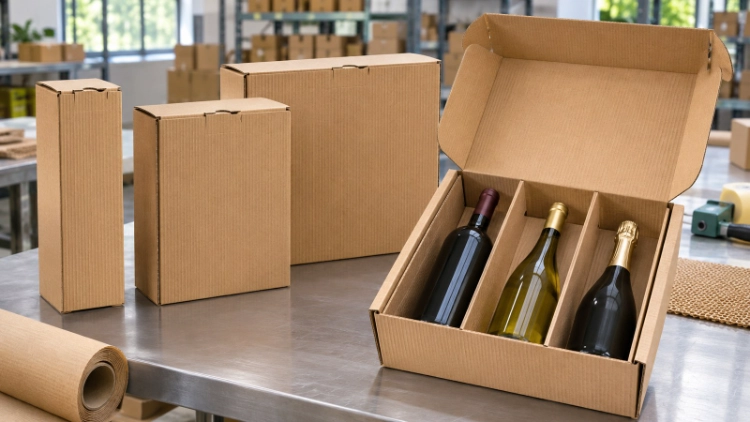
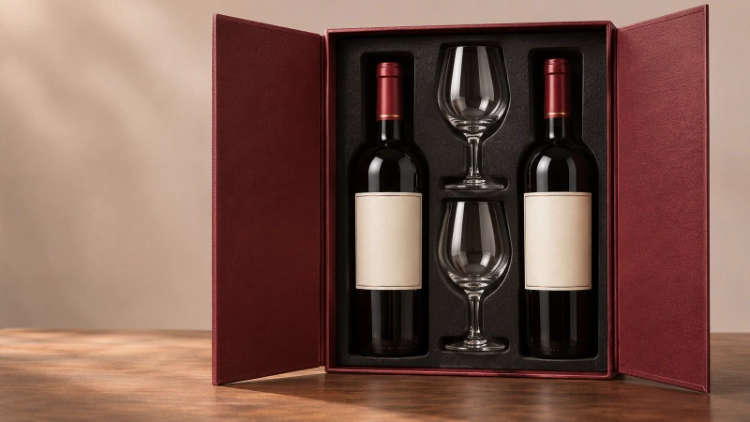
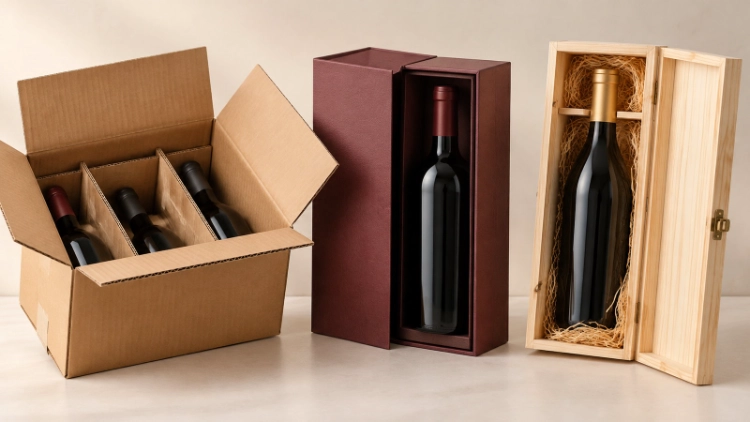
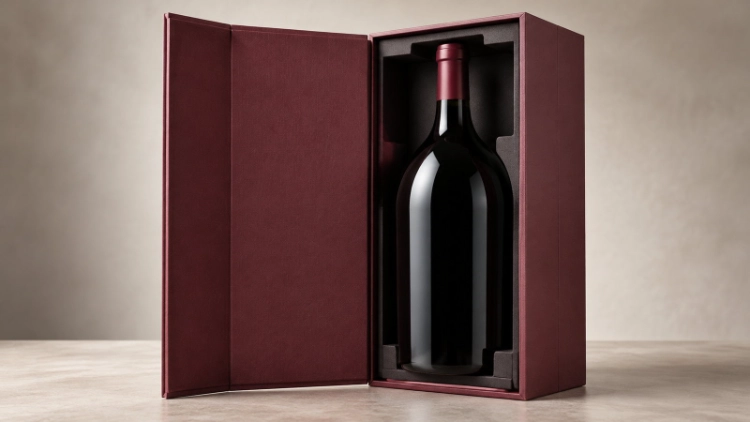
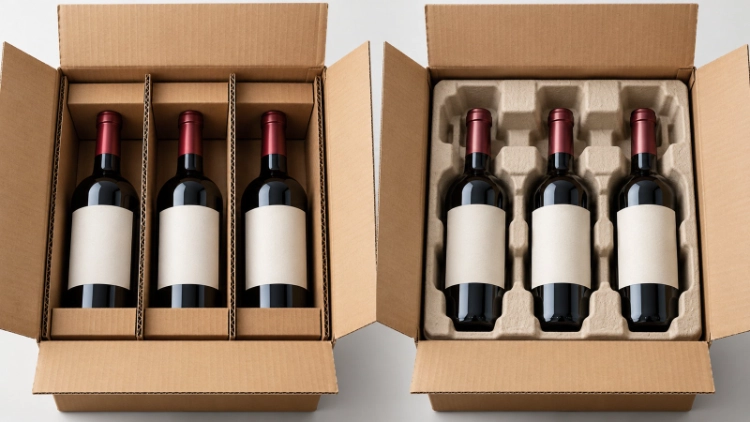
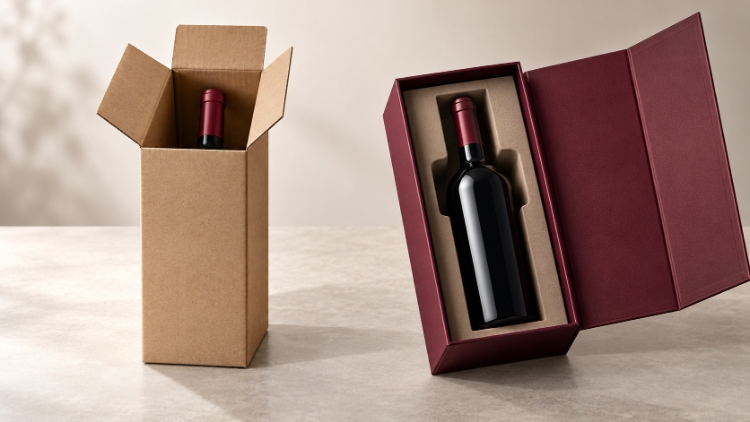
A single-bottle shipper may use folded corrugated supports or a shaped insert around the bottle. In a two-bottle box, the center separation becomes important. A three-bottle arrangement may place all bottles in a row, but the final footprint depends on the chosen structure and carrying requirements. Each format should be checked with all positions occupied rather than with one empty bottle cavity.
TopWinePack has an eco-friendly corrugated wine box with single-, double-, and triple-bottle options. Its published design includes a display window and top carrying handle, showing how the layout changes alongside the presentation features. It is not presented as a standard six- or twelve-bottle transport carton, and a larger case requires its own dimensional design.
Six- and Twelve-Bottle Grid Arrangements
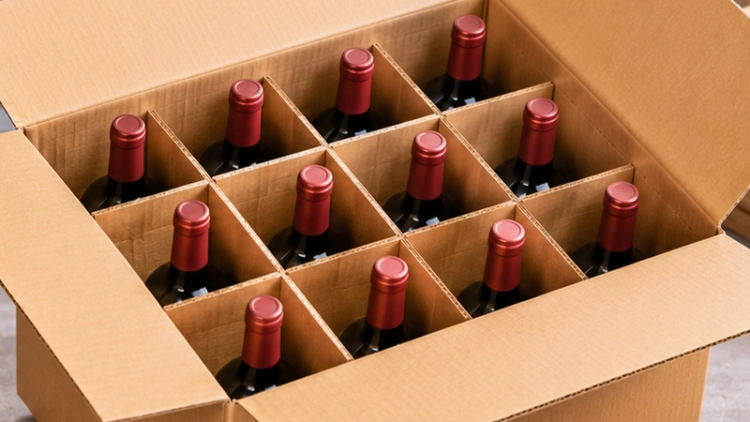
A six-bottle upright case commonly starts with a 2 × 3 grid; a twelve-bottle case can be sketched as 3 × 4 or 2 × 6. These are layout options, not approved standard sizes. The longer 2 × 6 footprint might suit one pallet pattern but create handling difficulties in another. A more compact 3 × 4 arrangement changes how the carton fits beside adjacent cases and how partitions are cut and assembled.
For mixed bottle profiles, a uniform grid may not be appropriate. If a case contains both a standard wine bottle and a wider sparkling-wine bottle, the widest bottle can determine cell width, or the design may need distinct cell sizes. Do not assume all bottles fit simply because their nominal capacity matches.
The earlier wine shipping box guide covering dimensions, materials and safety provides broader packaging considerations. This sizing approach focuses on how an actual bottle grid becomes a carton specification.
How Is Divider Fit Reflected in Carton Dimensions?
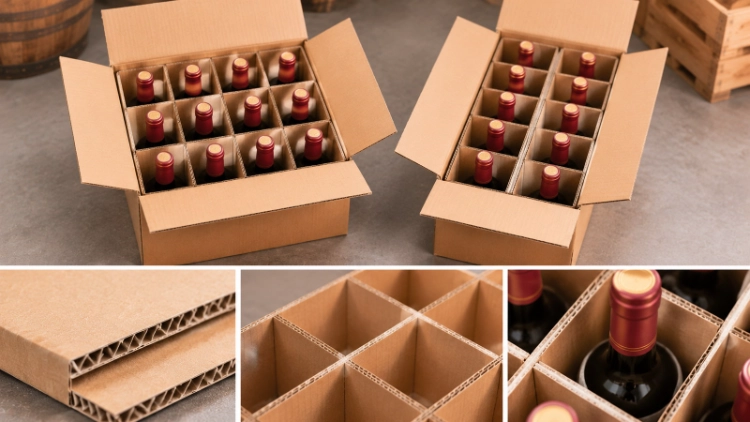
For upright bottles, the relevant dimension is the cell pitch: the distance assigned to one cell in the grid, including its bottle clearance and the partition space. If the grid contains n columns, the usable length is approximately n × cell pitch, subject to the outer walls, end cells, divider construction, and any additional supports. The width follows the same logic with the number of rows. This is a planning relationship, not a cutting die specification.
Partition Thickness and Slot Engagement
A corrugated divider occupies real space. Its board caliper, interlocking slots, and contact with the carton walls change the cell dimensions. Simply multiplying the bottle diameter by the number of columns will underestimate the required space. On the other hand, increasing every cell indiscriminately may leave too much clearance.
At the sample stage, assemble the divider exactly as packing staff will. Loose slots can let partitions lean or lift from the bottom; overly tight slots can damage the board during assembly. Check that the divider height separates the bottles where contact is most likely and does not interfere with the top closure. Neither a taller divider nor a thicker board automatically guarantees better transit performance.
Formed Inserts Use a Different Geometry
Molded pulp and other shaped inserts position the bottle through defined cavities rather than a simple cross-partition grid. The cavity wall, nesting features, top and bottom supports, and the way the insert locks into the carton influence its footprint. A cavity that hugs the lower body but leaves the shoulder uncontrolled can still allow movement.
How Should Internal and External Carton Sizes Be Specified?
Internal length × width × height describes the usable space inside the assembled carton. External dimensions describe the finished outside of that carton, including its walls, flaps, folds, and manufacturing construction. The difference is not necessarily a single value that can be added to every dimension. Board type, flute profile, folding pattern, and closure details all influence it.
A useful sizing sheet should record the bottle drawing, packing orientation, number of cells along each direction, divider type, and proposed internal carton dimensions. After a mock-up, measure the assembled outside as well. This avoids the common mistake of placing external dimensions on a purchase order when the packing team actually needs usable internal space.
| Packaging layout | Primary footprint question | Important check |
| Single bottle | Does the insert locate the whole bottle? | Neck clearance and base support |
| Two or three bottles | Does the center separation stay in position? | Glass-to-glass contact and balance |
| Six bottles, 2 × 3 | Does the grid fit the selected bottles? | Cell pitch and divider assembly |
| Twelve bottles, 3 × 4 | Does the compact grid suit storage and handling? | Full-case weight and partition stability |
| Twelve bottles, 2 × 6 | Is the longer footprint practical? | Pallet fit, carrying and carton length |
A drawing may show adequate clearance, yet packed samples can expose a partition that buckles or an end cell that becomes narrower after folding. The TopWinePack wine shipping box range illustrates different corrugated formats; any new multi-bottle layout should be reviewed as a separate structural project.
When Do Pallet and Shipping Conditions Affect the Size?
The most compact individual carton is not always the most efficient distribution carton. Cases have to share a pallet footprint, tolerate handling and possible stacking, and fit the way orders are assembled at the winery. A small change in external length may alter how many cartons fit along a pallet edge. That consequence cannot be inferred from bottle count alone.
Distinguish individual parcel shipments from case shipments moving as a unit load. A carton traveling through a parcel network faces different handling from a palletized case, and the required packaging validation may change. If shipping tests are specified, test the assembled pack with the actual bottles, divider, sealing method, and outer carton rather than an empty prototype.
What Should Be Checked Before Production Is Released?
Start with a filled structural sample. Load every position with production bottles, close the flaps, and confirm that the divider remains seated. Look for scuffed labels, contact between neighboring bottles, excessive gaps at the case ends, and pressure near closures. A single bottle standing firmly in one cell does not prove the full grid will work.
Next, record both internal and external dimensions from the approved construction. Check how the divider is assembled and whether the same result can be repeated by packing staff. If the insert is supplied flat, confirm how it is packed and identified. When several wine bottle styles share a carton design, test each intended combination rather than relying on a nominal 750 mL specification.
TopWinePack’s OEM/ODM customization service supports changes to box size, structure, material, and inserts. A useful enquiry should include the bottle drawing, bottles per case, layout sketch, intended route, packing method, and any customer test requirements.
Send your shipping carton dimensions and divider requirements when those details are ready for review.
Conclusion
A workable wine shipping carton starts with a bottle envelope and a packing layout, then leaves room for the real divider construction. Record the internal dimensions after the insert has been assembled and distinguish them from the external size needed for storage or pallet planning. The final approval should come from a full-case sample, not a stock-size chart or an empty box.
FAQs
Q1: Is there one standard size for a twelve-bottle wine shipping box?
No. Bottle profile, packing orientation, divider construction, and carton design change the dimensions. A 3 × 4 or 2 × 6 arrangement establishes a possible grid, but the final measurements should come from the intended bottles and insert.
Q2: Why does a divider change the required carton dimensions?
Partitions occupy space and determine the distance between bottles. Board thickness, slot engagement, and end-cell geometry affect usable space. A carton measured without its divider may not fit the finished packing arrangement.
Q3: Should a custom wine shipping box be specified by internal or external size?
Record both. Internal dimensions control the usable space for bottles and inserts; external dimensions matter for storage, handling, and transport planning. The two measurements are not interchangeable.