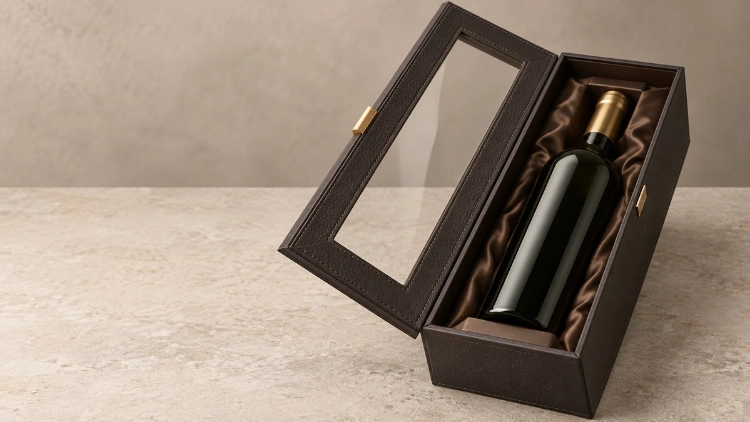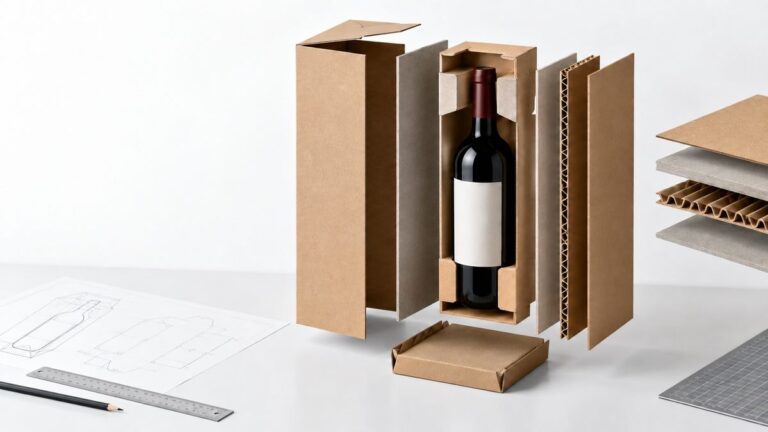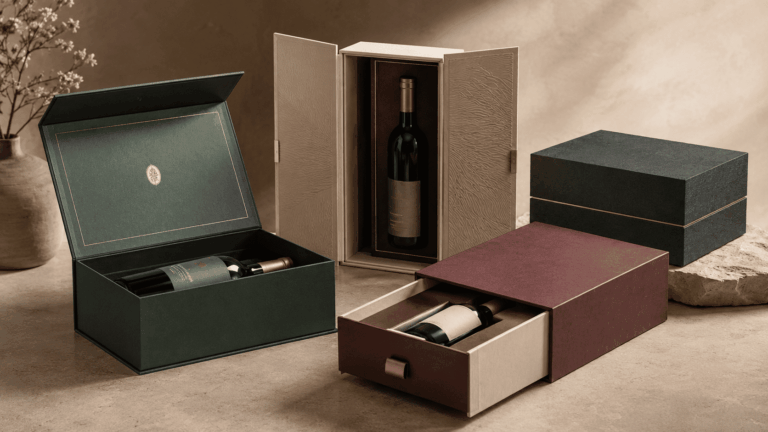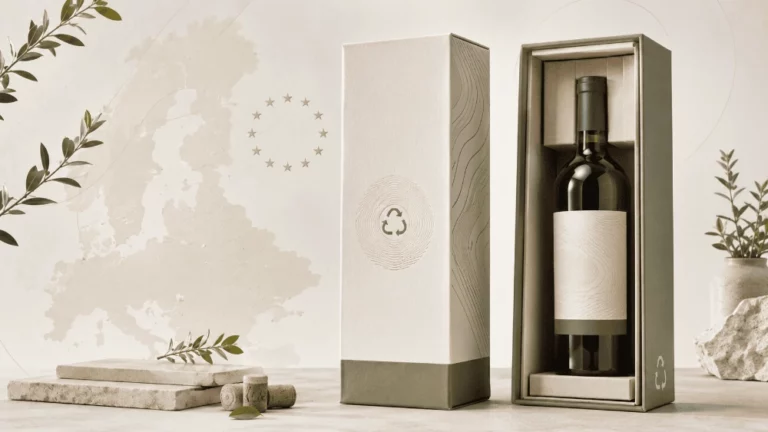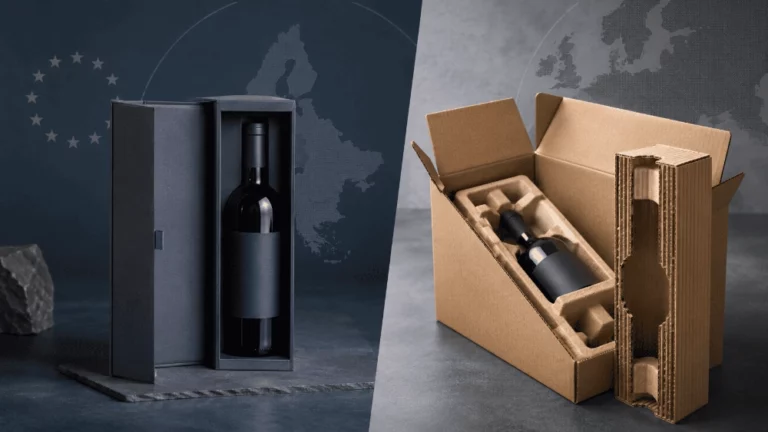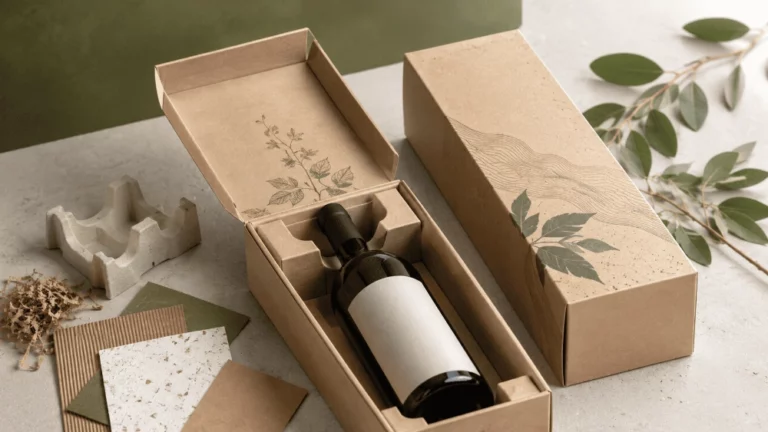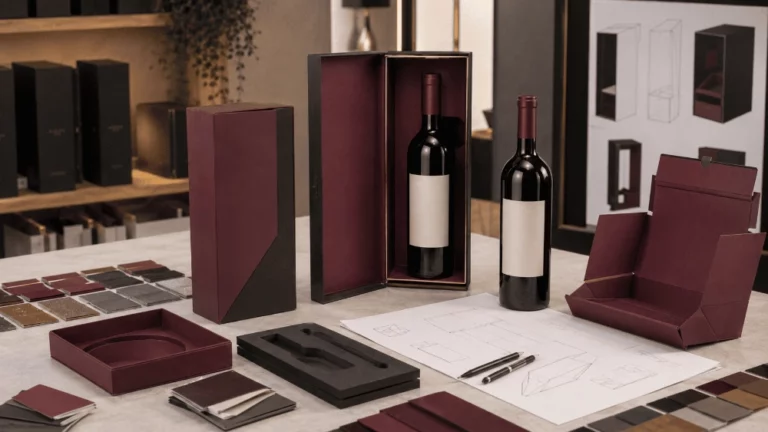

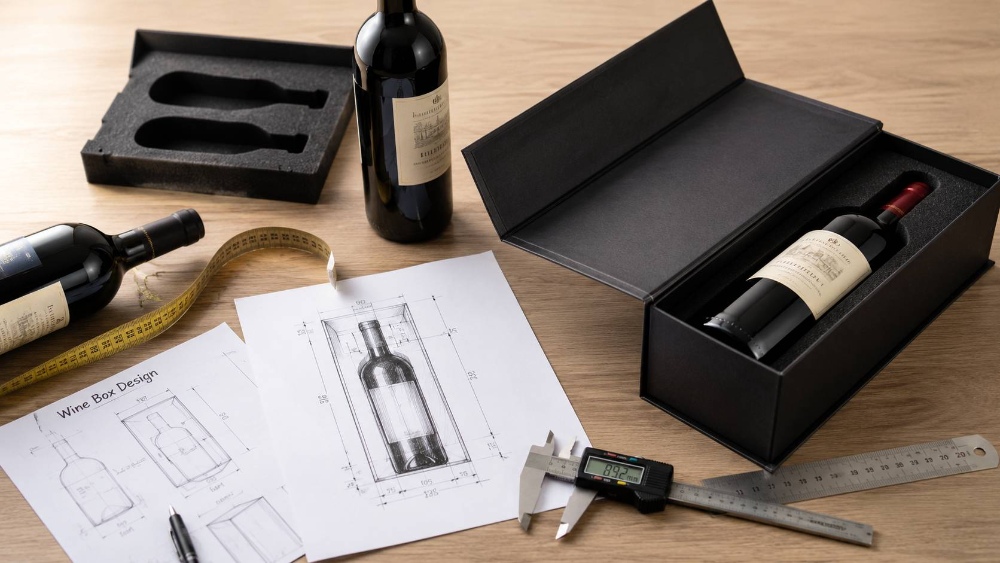
A custom box should not be sized from bottle capacity alone. Two bottles marked 750 ml can have different heights, body diameters, shoulders, necks, bases, closures, and filled weights. If the packaging team relies only on nominal volume, the bottle may sit too tightly, move inside the insert, prevent the lid from closing, or overload one area of the box.
Accurate custom wine box dimensions begin with the finished, filled, and sealed bottle. The buyer then defines orientation, insert, clearance, board thickness, structure, and accessories before sampling.
Why Bottle Capacity Cannot Define the Final Box
Capacity describes internal volume, not external shape. Bordeaux-style, Burgundy-style, sparkling-wine, and spirits bottles may hold a similar volume while using different proportions. Heavy bases, long necks, wax seals, or decorative caps can change the final profile.
A window or insert must also avoid covering important label information. A standard wine box size should therefore be treated only as an initial reference.
Step 1: Measure the Complete Filled Bottle
Record all measurements from the final commercial bottle, including its closure, label, decorative elements, and filled weight.
Measure Height, Closure, and Maximum Diameter
Measure from the lowest point of the base to the highest point of the closure. Include any cork, cap, foil, wax seal, neck decoration, or security feature that extends beyond the glass. Record the widest body point rather than only the center diameter.
If several bottle versions will use one box, measure each and use the largest critical dimension rather than an average.
Record Shoulder, Neck, and Label Position
Measure the widest shoulder, the height where the shoulder begins, the neck diameter, and the usable neck length. These values show where an insert can hold the bottle without pressing on the label or closure.
Record front and back label positions for any window, cutout, or display opening. Complete wine bottle measurements should cover visible areas as well as the glass profile.
Include Filled Weight and Accessories
Use the finished bottle weight, not the empty container. Filled weight affects the bottom board, insert density, handle, and closure. In a multi-bottle design, it also affects balance and divider strength.
List all accessories at the same stage because their size, weight, and position can change the internal layout and final custom wine box dimensions.
Step 2: Convert Bottle Data into Internal Box Dimensions
Once the bottle record is complete, define the usable internal space. Internal box dimensions are not the bottle measurements plus an arbitrary allowance. They must reflect how the bottle will be held.
Set Orientation and Support Points
Decide whether the bottle will stand upright, lie horizontally, sit at an angle, or form part of a multi-bottle arrangement. Orientation determines which surfaces carry the load and which parts require restraint.
A stable layout supports the base, body, shoulder, or neck in a deliberate combination. Horizontal bottles need anti-roll support, while upright bottles need a firm base that prevents leaning.
Add Clearance Without Creating Movement
Internal width can be treated as the maximum bottle diameter plus insert walls and side clearance. Internal height combines total bottle height, top support, bottom support, and closing clearance. These formulas provide a framework, not one universal allowance.
Too little clearance can compress the label or stop the lid from closing; too much permits movement. The allowance depends on material stiffness, friction, filled weight, and assembly. Wine box inserts must be selected before the internal box dimensions are frozen.
Plan Multi-Bottle Spacing
For two or more bottles, include each maximum diameter, the central divider, outer supports, and required clearance. Broad shoulders may overlap even when the bottle bodies appear to fit.
The divider should prevent bottle contact and support the structure. Assign accessory compartments before calculating total width.
Step 3: Adjust the Layout for Wine Box Inserts
Wine box inserts are part of the dimension system. Their thickness, density, wall shape, and covering can change the cavity.
EVA and Flocked Foam
EVA can follow the bottle profile and provide firm positioning when its density and thickness suit the filled weight. The opening should hold the bottle without excessive compression. Flocking or fabric covering adds thickness and changes friction.
A heavy bottle may compress soft foam over time. Check the sample after a holding period, and confirm clean cut edges with adequate support beneath the base.
Molded Pulp and Paperboard
Molded pulp uses formed walls, draft angles, and molded edges that affect cavity size. A paperboard divider may suit regular bottle shapes, but it still needs accurate slots, folds, and locking points.
Paperboard and molded pulp cannot use the same allowance as foam. Fix the structural concept before approving custom wine box dimensions.
Accessory Compartments
A combination set should assign a defined space to every item. Accessories must not touch the bottle, scratch the label, or fall out when the lid opens.
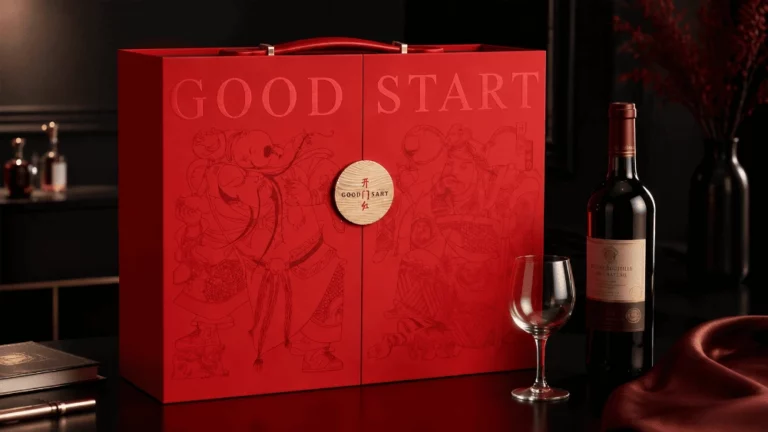
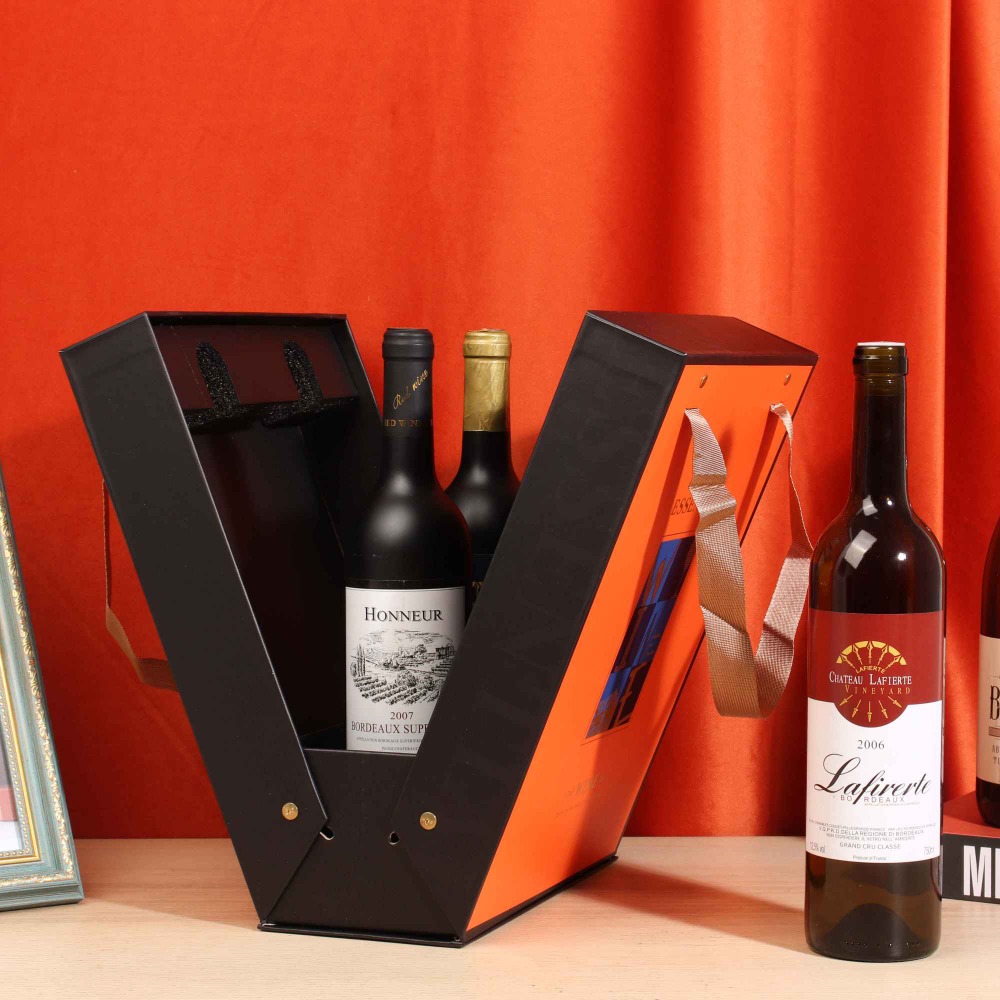
The Luxury Double-Door Rigid Wine Gift Box shows how presentation can expand the layout beyond one bottle cavity. The format uses a symmetrical double-door opening and rigid cardboard, with optional magnetic closure, ribbons, metallic elements, and tailored internal arrangements. These features belong in the first dimension drawing.
Step 4: Convert Internal Box Dimensions into External Dimensions
After the internal layout is fixed, add the physical structure that surrounds the cavity.
Add Board and Wrapped Material Thickness
Rigid board, surface paper, lining, adhesive, and reinforcement add thickness based on panel overlap and edge wrapping.
The external wine box size should come from the assembled structure, including lid, base, sleeve, or closing panels. Documents should clearly distinguish internal cavity size from finished external size.
Account for the Opening Structure
A lid-and-base box needs controlled overlap, a drawer needs clearance between tray and sleeve, and a magnetic box must account for its spine, flap, walls, and magnets. Foldable rigid boxes also need crease panels and accurate corners.
TopWinePack’s custom wine packaging service covers magnetic, lid-and-base, drawer, foldable, double-door, window, and handled formats. Each structure changes the relationship between internal and external dimensions. Select the structure before approving the final wine box size.
Check Handles and Hardware
Handles and fittings may project beyond the board or enter the cavity at their fixing points. Magnets and ribbons may also change closing thickness.
Measure the completed box at its longest, widest, and highest points before calculating master cartons. For UPS package measurements, the longest points define length, width, and height, a useful discipline for complete external data.
Step 5: Verify the Dimensions with a Physical Sample
A drawing shows calculated fit. A sample shows how the bottle, insert, board, closure, and handling features work together.
Check Bottle Fit and Movement
Place the finished bottle into the sample without forcing it. It should sit level, with no pressure on the label, closure, or decoration. Move and tilt the box gently to check for sliding, rolling, or vertical lift.
Remove the bottle and inspect for abrasion. In multi-bottle designs, confirm that the divider remains straight and bottles do not touch. These checks show whether the wine bottle measurements were transferred correctly.
Check Closure, Base, and Carrying Performance
Close the box with all contents inside. The lid should not bulge, moving parts should operate correctly, and the bottom should remain flat under the filled weight.
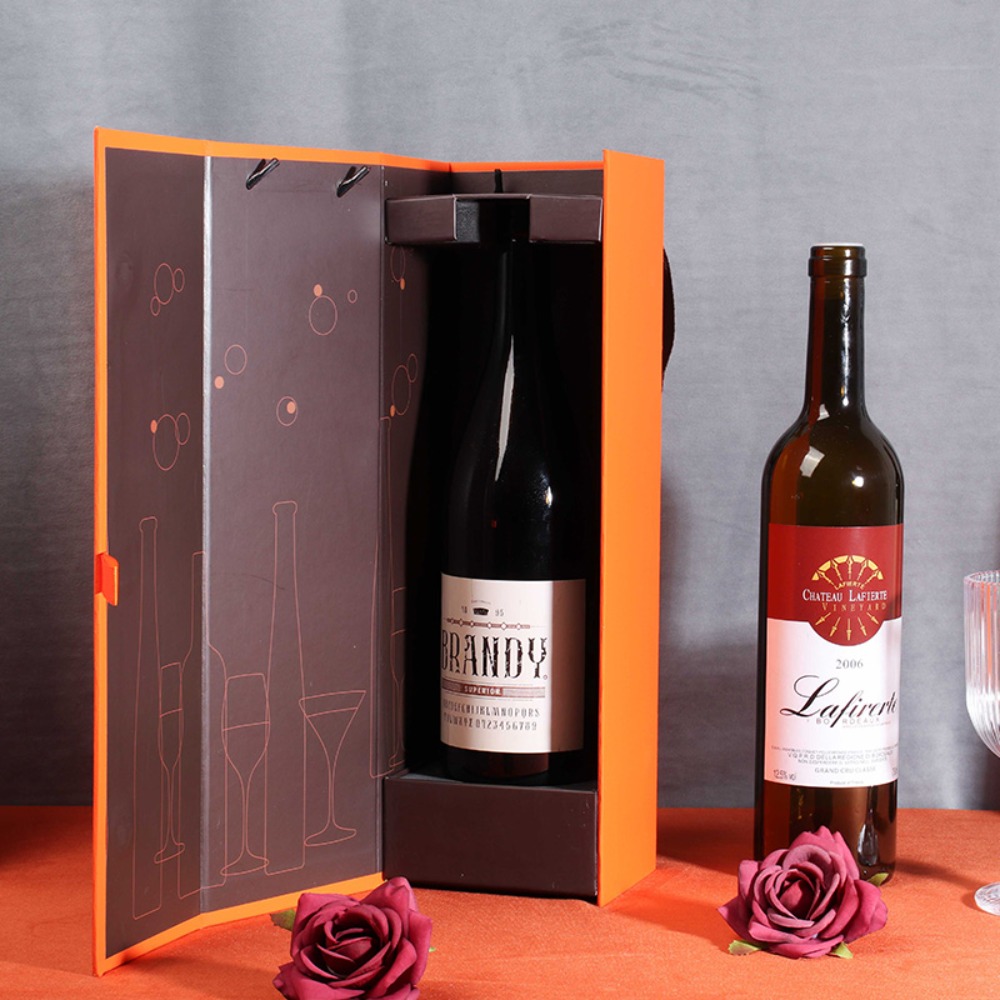
If the box has a handle, lift the complete sample and inspect the fixing points and weight balance. The Single Bottle Foldable Cardboard Wine Box Customized With Ribbon Handle uses rigid cardboard, a foldable single-bottle structure, UV texture printing, and a ribbon handle. Its size, color, print, and handle can be customized, but the final bottle profile and filled weight still need to be checked.
Freeze the Production Dimension Sheet
After approval, record the bottle version, total height, maximum diameter, shoulder and neck data, filled weight, internal cavity, insert opening, external dimensions, board specification, structure, accessory positions, and accepted tolerances.
Match the approved sample to the dimension sheet. If the bottle changes, repeat the affected measurements and fit checks.
A Practical Measurement Worksheet
| Item | Data to Provide | Effect on the Box |
| Total height | Base to highest closure point | Internal height and lid clearance |
| Maximum diameter | Widest bottle point | Internal width and insert cavity |
| Shoulder and neck | Width, height, and transitions | Support and restraint positions |
| Filled weight | Complete commercial bottle | Base, insert, handle, and closure |
| Label position | Front and back visible areas | Window and insert contact |
| Bottle quantity | One or several bottles | Divider and total layout |
| Accessories | Dimensions, weight, and position | Compartments and balance |
| Box structure | Lid, drawer, magnetic, foldable, or double-door | External calculation |
From Bottle Data to a Production-Ready Box
For a custom project, buyers can provide a bottle or complete measurement sheet, filled weight, quantity, preferred structure, insert requirement, and artwork. TopWinePack can develop the layout through structural review, material selection, sampling, and production confirmation.
The reliable sequence is direct: measure the final bottle, define support, calculate the cavity, add the insert and structure, then approve the sample. This produces custom wine box dimensions based on the real product rather than nominal capacity.
To prepare a dimension review, send the bottle drawing or sample details, filled weight, box format, and insert preference through TopWinePack’s custom project form. We can turn the data into a sample-ready specification before production begins.
FAQ
Q: Is there one standard wine box size for every 750 ml bottle?
A: No. Bottles with the same capacity can differ in height, diameter, shoulder, neck, base, closure, and weight. A standard wine box size remains a reference until the actual bottle has been measured and tested.
Q: How much clearance should be added around a wine bottle?
A: There is no single allowance for every project. Clearance depends on the insert material, bottle weight, surface friction, structure, and packing method. Confirm it through a physical sample.
Q: Do wine box inserts change the external dimensions?
A: Yes. EVA, flocked foam, molded pulp, paperboard dividers, and accessory compartments use different wall thicknesses and support methods. Their space must be added before the board and external structure are calculated.